Questions & Answers
Getting Started
What is free, and which Pro plan should I choose?
Weathergraph is free to download. Read hourly forecasts inside the app with all options and themes; free widgets show demo data. Pro unlocks all widgets with your forecast, Apple Watch complications, nowcast, rain alerts, multiple locations, radar data and Superforecast, which compares multiple forecast models at once.
Choose Yearly Pro or a one-time Pro Forever purchase, for you or your family.
The free tier and Pro guide compares access, explains trials and family sharing, and shows where to check your current price.
How do I read the weather?
Here's a quick guide to reading the weather chart:
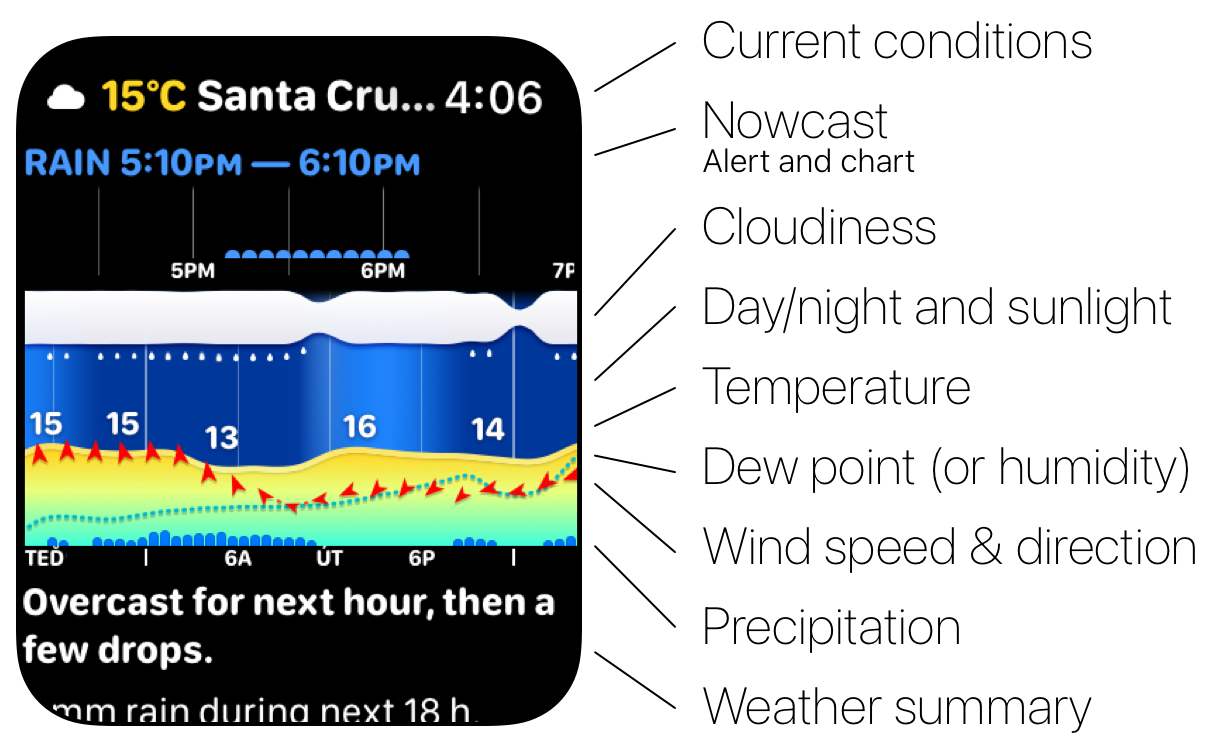
How to Read the Charts
Day/Night Sky and Sunshine: The chart background shows the day/night cycle and sunshine intensity—the brighter the background, the sunnier it is.
Cloudiness: The top layer shows cloud cover (percentage of sky obscured by clouds).
Sun Glow: A warm glow above the cloud layer highlights especially sunny periods.
Wind Speed and Direction: The taller the chart, the stronger the wind. Arrows indicate wind direction; double arrows indicate gusts.
Temperature: The main colored chart shows temperature (actual or "feels like," based on your preferences). The dashed line marks the freezing point (0 °C / 32 °F).
Rain/Snow and Precipitation Probability: The bar chart shows precipitation amount (blue = rain, white = snow), while the light blue area shows precipitation probability (0–100%).
Humidity or Dew Point: You can display relative humidity (RH) or dew point as a blue dotted line. This also shows the dew point comfort level in forecast details. Humidity ranges from 0–100%, where two-thirds of the chart height equals 100%. Dew point shares the same scale as temperature.
Guide: How to read an hour-by-hour weather graph — the same chart, layer by layer, with worked examples.
How do I change complications on my Apple Watch watchface?
Apple has made a great step-by-step guide to changing and customizing watchfaces.
Guide: Apple Watch weather complications: choose a useful glance — which complication to pick, and how often each one updates.
Where can I find ready-made watchfaces?
Check out the Weathergraph watchfaces page for ready-made Apple Watch watchfaces featuring Weathergraph complications, ready to install with a single tap.
App Features
Does Weathergraph include radar?
Yes. Pro includes radar data so you can follow precipitation on the map.
Can Weathergraph compare multiple forecast models at once?
Yes. Superforecast, included in Pro, compares multiple forecast models at once. It helps you see where they agree and where the forecast is less certain.
What languages does Weathergraph support?
Weathergraph is fully translated into 21 languages:
- Arabic
- Chinese (Simplified)
- Chinese (Traditional)
- Czech
- Danish
- Dutch
- English
- Finnish
- French
- German
- Greek
- Italian
- Japanese
- Korean
- Norwegian Bokmål
- Polish
- Portuguese (Brazil)
- Portuguese (Portugal)
- Slovak
- Spanish
- Swedish
The app interface and forecast text use your selected language. Tap the gear icon at the lower right → choose Preferences to select a language, or use the system default.
How does Nowcast work?
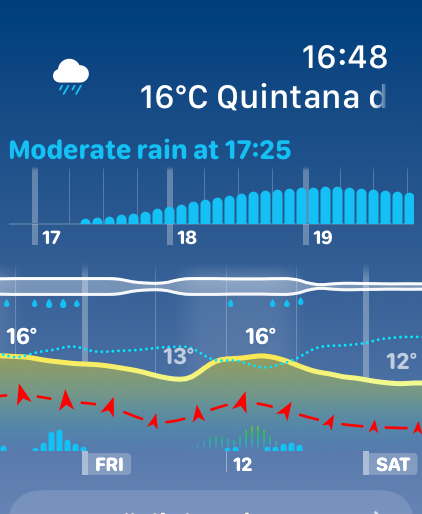
With Pro, Weathergraph checks for upcoming precipitation approximately every hour using short-range nowcast radar data.
If rain, sleet, or snow is detected in the forecast window ahead, you'll see a warning on the widget—including the expected start time and precipitation type.
When no specific precipitation is detected yet but the probability reaches 33% or higher, Weathergraph displays the chance instead.
Guide: Nowcast vs. radar vs. hourly forecast — what each of the three can and cannot tell you.
Does Weathergraph alert me about upcoming rain or snow?
Yes! The Pro version checks for upcoming rain or snow approximately every hour using short-range nowcast data, and alerts you when precipitation is on the way. Make sure Low Power mode is off on your iPhone and Apple Watch, as it disables background updates for all third-party apps.
Guide: Nowcast vs. radar vs. hourly forecast — why a nowcast alert covers the next hour and the hourly forecast covers the day.
Why do I see 'dry' when the humidity is 98%? Understanding dew point comfort scale
The "dry" label comes from the dew point—not relative humidity. These two measures tell very different stories.
Why relative humidity misleads you
Relative humidity (RH) is a ratio: it compares the moisture actually in the air to the maximum that air could hold at its current temperature. The problem is that warm air can hold far more moisture than cold air. So the same absolute amount of water vapor reads as 98% RH at −1 °C, but only 40% RH at 25 °C.
What dew point actually measures
The dew point is the temperature at which air would need to cool to reach saturation. It's an absolute measure of how much water vapor is in the air—it doesn't change just because the temperature does. Cold winter air at −1 °C and 98% RH has a dew point of about −1 °C, which means only roughly 2–3 grams of water vapor per kilogram of air. That's genuinely dry—your skin and airways feel it. Heating that same air indoors to 21 °C drops the RH to around 20%, making it even drier.
Why it matters for how you feel
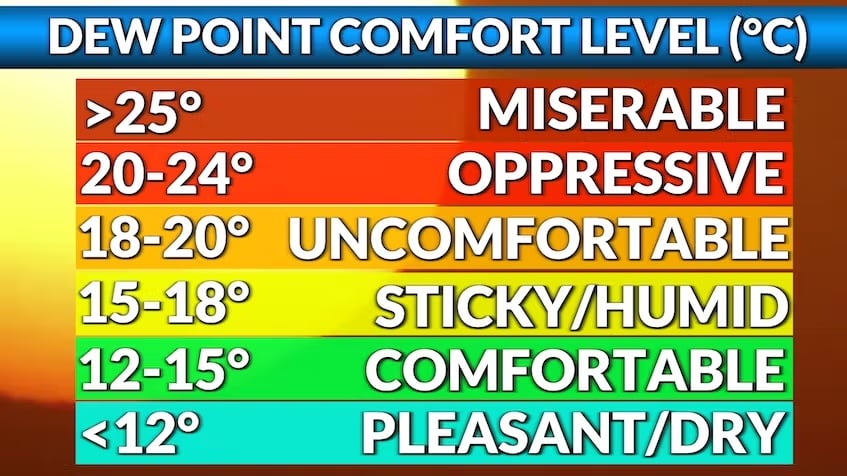
Your body cools itself by sweating. When the dew point is high, the air is already saturated with moisture and sweat can't evaporate efficiently—so you feel hot and sticky even if the temperature is moderate. The National Weather Service uses dew point (not RH) to classify mugginess for exactly this reason.
Here's the comfort scale Weathergraph uses:
If you would like to read more about how this works, Alex has a great article about why dew point is a more useful measure of humidity, especially for runners.
Guide: Dew point vs. humidity: how muggy will it feel? — the comfort ranges, and how to plan a hot day around them.
How do I change the number of days shown in the iOS widget?
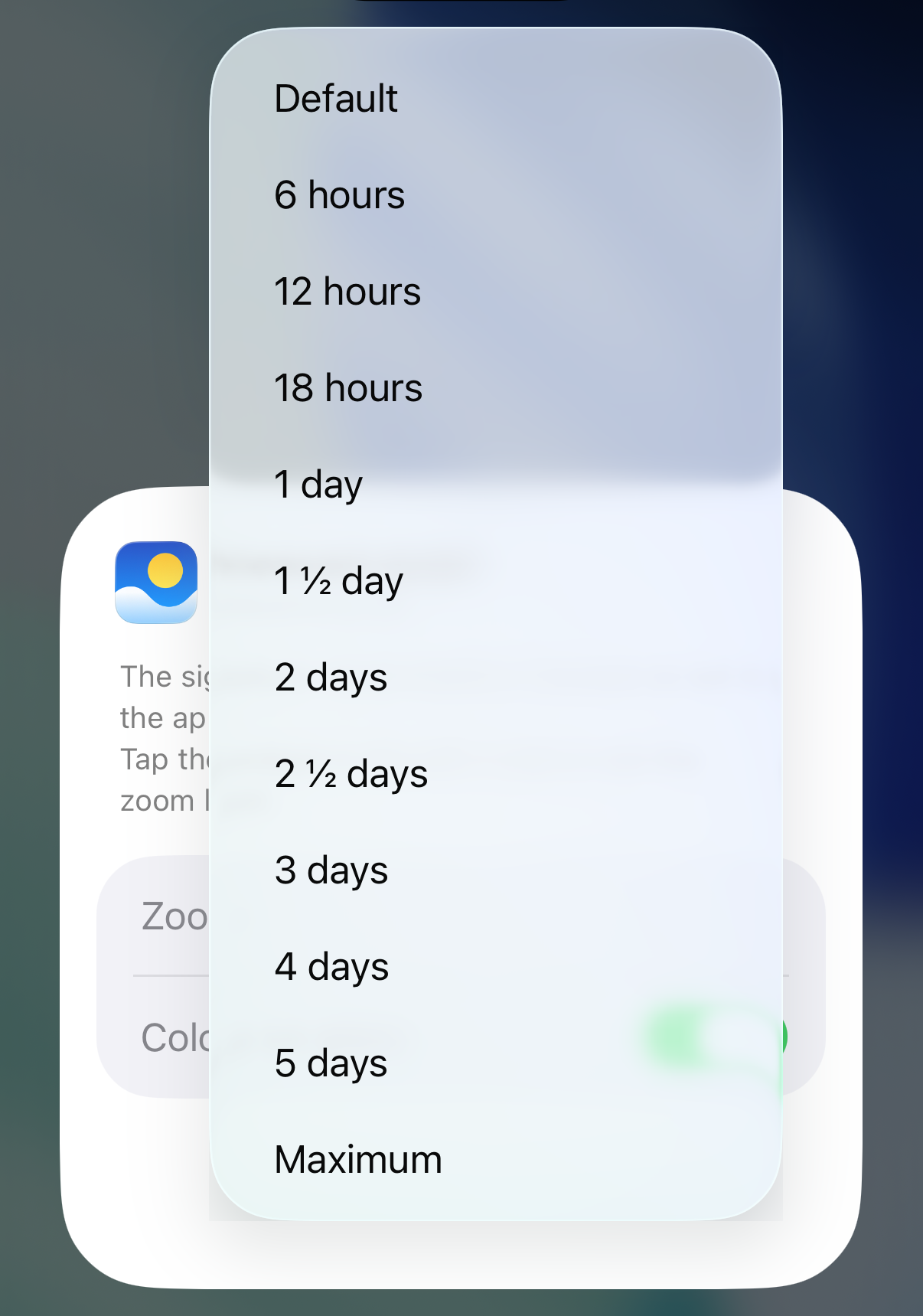
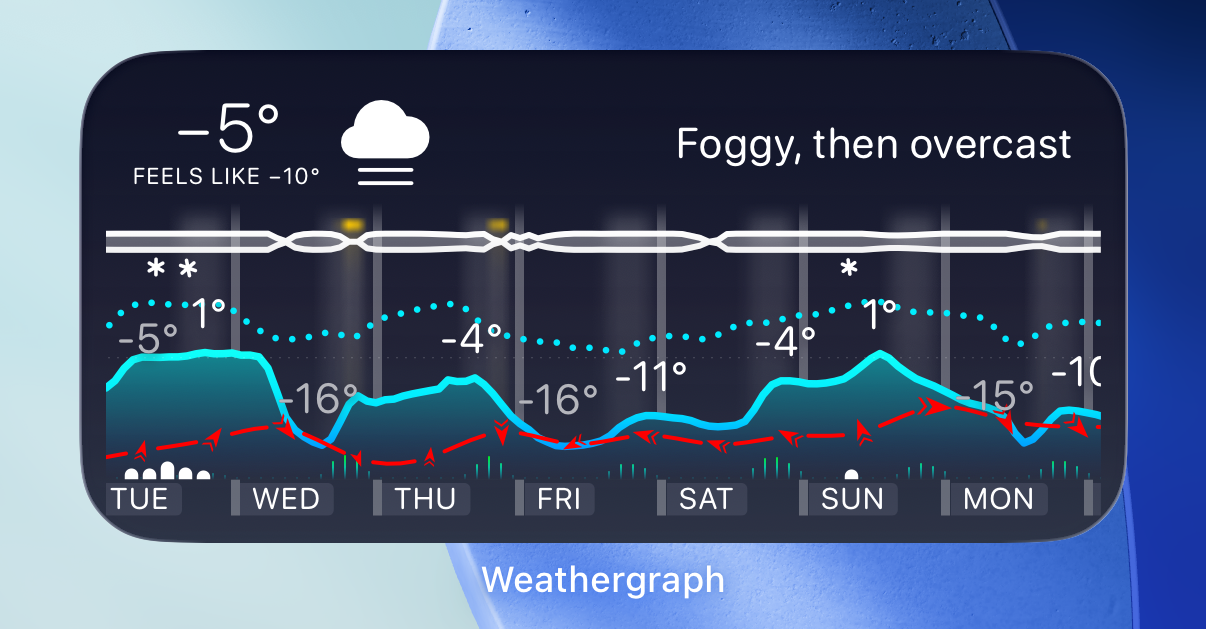
You can adjust how many days appear in the iOS widget by editing the widget settings on your home screen.
1. Long press the widget on the homescreen, select Edit Widget:
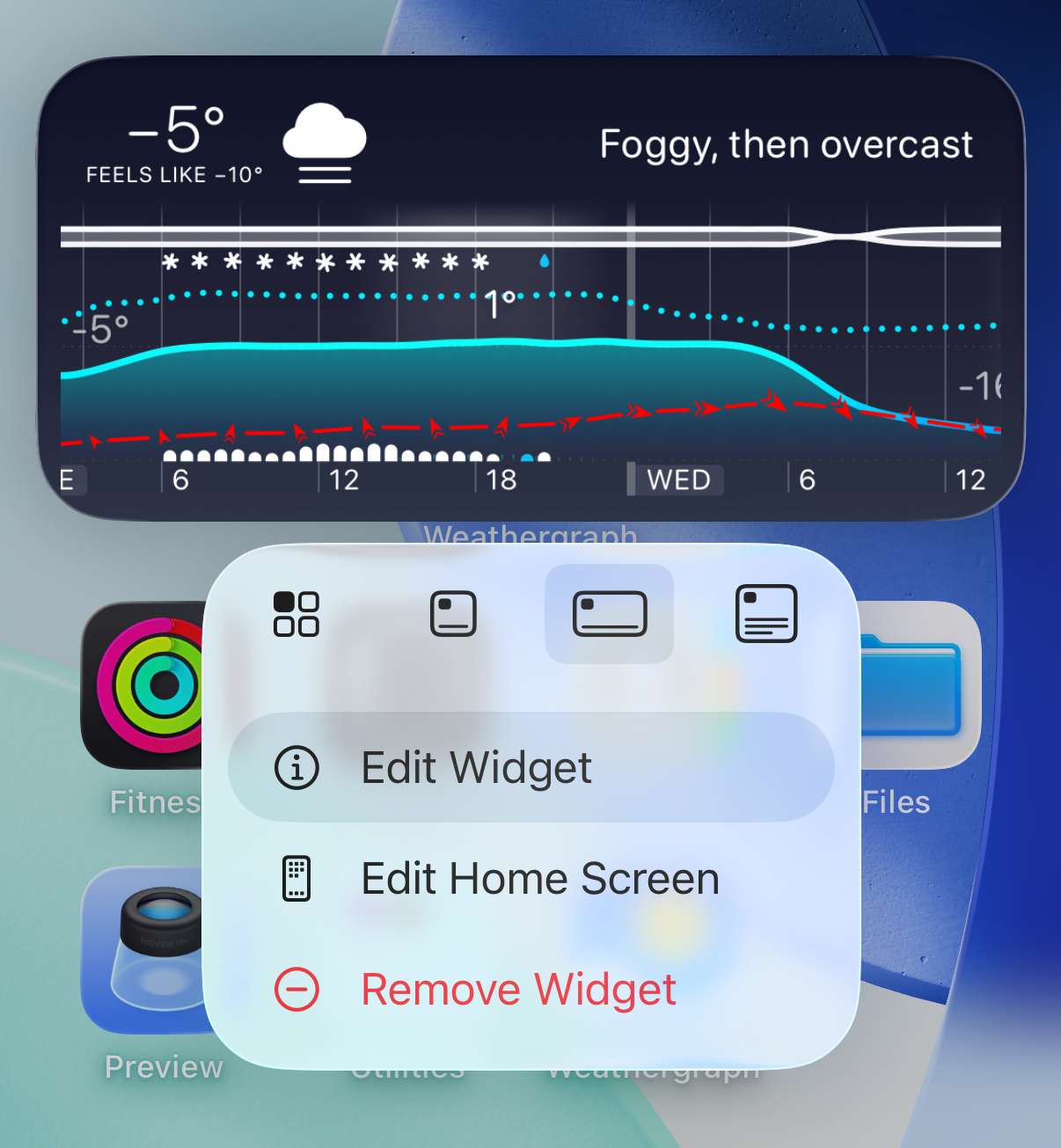
2. Tap Zoom and select the desired chart zoom level:
3. Get up to 7 days forecast at a glance:
How do I change the number of days shown in the watchOS widget?
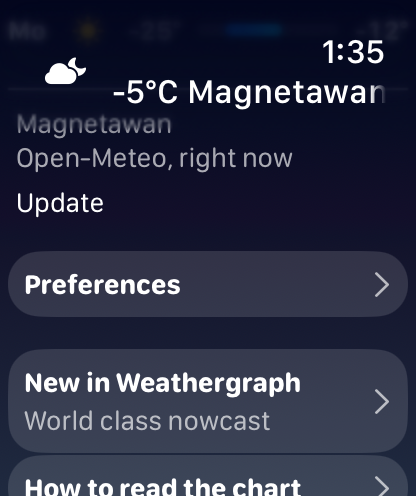
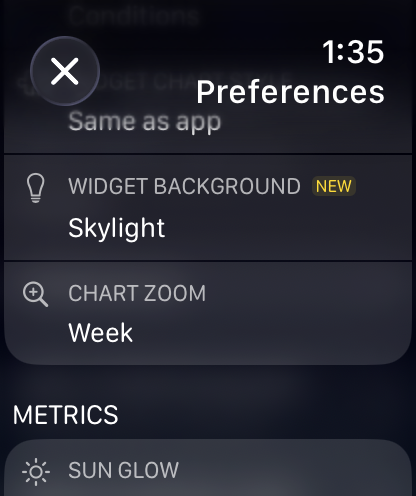
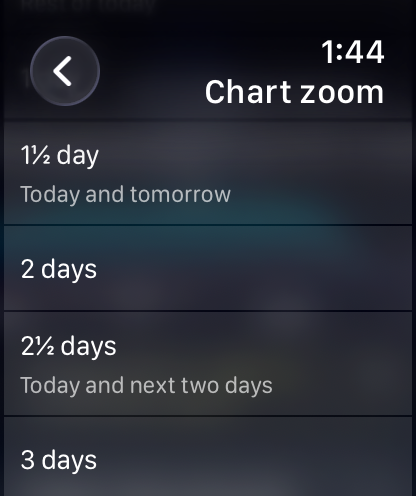
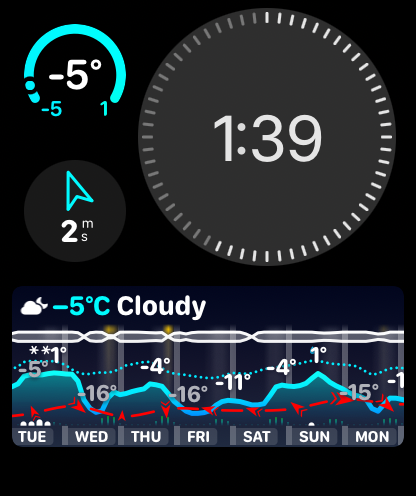
You can adjust how many days appear in the watchOS widget by changing the Chart Zoom setting in the watchOS app preferences.
1. Scroll down to Preferences in the watchOS app:
2. Scroll down to the Widgets section:
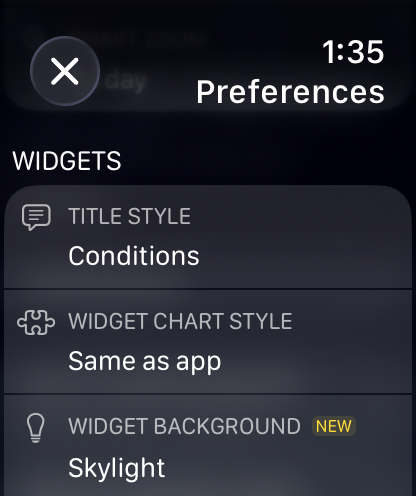
3. In the Chart zoom setting, pick Week:
The result:
How do the next 24 hours min/max widgets work?
These widgets show the current temperature (or precipitation) plus the min/max range for the next 24 hours—not today's calendar day.
Why? Weather APIs only provide forecasts starting from "now." If today's coldest moment was at 6 AM and it's already noon, that data is gone—we can't show you a minimum that already happened.
I tried storing past minimums from earlier forecasts, but it got confusing quickly. Imagine driving through mountains and your widget shows "today's low: -5°C" from a mountain pass you crossed at dawn, even though it's 15°C where you are now. Not helpful!
The simpler, more useful approach: show what's coming in the next 24 hours. After all, you want to know if it'll get cold tonight—not what happened while you were sleeping.
Does Weathergraph support multiple locations?
Yes! With Pro, you can save any number of named locations and switch between them with a tap. Saved locations can be renamed, reordered, and deleted from the Manage Locations screen.
One thing to keep in mind: widgets and complications always show weather for your current GPS location, regardless of which saved location is selected in the app.
Troubleshooting
Widgets appear blank, or stopped updating (show outdated data)
This is a known iOS and watchOS bug where widgets stop updating. Technically, the widget system loses track of the file it uses to store widget data.
The reliable fix is to restart your device—either turn it off and back on, or use a force restart.
I first reported this to Apple in iOS 17 and watchOS 10. It kept reappearing in later versions, including the iOS 27 and watchOS 27 betas. In the final 27.0 releases, it seems to be gone at last. If you still encounter it, restarting your device remains the reliable fix.
Weathergraph cannot access my location
Please check Weathergraph's location permissions:
iPhone
- Open
Settingson your iPhone, go toPrivacy & Security→Location Services→Weathergraph - Set the permission to
Always(enables background updates and alerts) or at leastWhile Using the App or Widgets(updates only when the system refreshes widgets)
Watch
- Open
Settings, scroll down and go toPrivacy & Security→Location Services→Weathergraph - Set the permission to
Alwaysfor background updates and alerts to work. If the options are grayed out, set the permission on your iPhone instead.
Widgets aren't updating automatically (and display Update button)
Make sure Low Power mode is off. When enabled, it disables background updates for all third-party apps, preventing Weathergraph from refreshing weather data.
If Low Power mode is already off, try restarting your device.
If the widgets still don't update, please send me the debug logs and we will look into what is happening - thank you!
Weathergraph doesn't update my location unless I open the app
Please check your location permissions in Settings → Weathergraph → Location.
If it's set to anything other than Always, please select Always.
Also make sure Low Power mode is off—it disables background updates for all third-party apps.
Weathergraph keeps asking for location again and again
Please choose Allow While Using the App in the permission dialog. Weathergraph needs your location to show accurate weather (it's never shared with third parties—see our privacy policy). If you chose "Allow Once," the app will ask again each time.
To update permissions: open Settings → scroll to Weathergraph → tap Location → select While Using the App.
Weathergraph's location permission dialog appeared again even though I gave it `Allow while using the app` access, or I see `Weathergraph was denied permission to ask for a location` below the forecast
The Always location permission (needed for background complication updates) gets reset during iOS or watchOS updates.
Apple likely does this to prevent apps from tracking you indefinitely, but frequent minor security updates have been triggering this reset more often than intended.
I've suggested to Apple (rdar://FB9733269) that this should only happen with major updates (e.g., 8.0, 8.1), not minor security patches—but for now, it affects all updates.
I closed the app and it stopped updating in the background
If you swipe apps away from the task switcher on iOS or quit apps on Mac, they can no longer update in the background until you open them again.
Please keep Weathergraph running—it's designed to use minimal resources.
Widgets don't appear in the widget picker
This is a rare issue in iOS 17 and watchOS 10 that appears to be fixed in iOS 18 and watchOS 11. If you're on an older version, updating your device should resolve it.
Restarting your device can also fix this issue.
My watchOS 10 complications are broken, I only see dashes (--) instead of the content
This is caused by Apple's migration to a newer watch app format—something developers have little control over. The Apple developer forum thread explains the technical details, but essentially the migration sometimes caches the wrong app extension identifier, breaking complications.
Solution: Remove all Weathergraph complications from all watch faces at once (this forces watchOS to clear its cached complication data), then add them back.
If you find a better workaround, I'd love to hear about it!
How do I send debug logs?
On the iPhone and Mac:
- On iPhone, tap the gear icon at the lower right → choose Preferences. On Mac, open Preferences. Then scroll down → choose
Debug. - Tap
Upload logs - Send the 5-digit code that appears to support@tomaskafka.com
On the watch:
- Scroll to the bottom of the app and tap the gray version text
- On the debug screen, tap
Upload logs - Send the 5-digit code that appears to support@tomaskafka.com
Thank you!
Subscription Management
I re-installed Weathergraph. How do I restore my subscription?
On the iPhone:
Tap the gear icon at the lower right → choose Weathergraph Pro → tap Restore Purchases.
On the watch:
Scroll down in the app → tap Get Pro → tap Restore purchases.
How can I change my subscription plan?
Go to Settings → [your name] → Subscriptions → select Weathergraph and choose your preferred plan. Here is Apple's guide.
How can I change from a subscription plan to Forever?
- Cancel the existing subscription first: Go to
Settings→[your name]→Subscriptions→ selectWeathergraph→ cancel the subscription (see Apple's guide). - In Weathergraph: Tap the gear icon at the lower right → choose Weathergraph Pro → select the Forever option and confirm.
I am not sure if the purchase succeeded — how can I check my active subscriptions (or cancel them)?
Here is Apple's guide: Manage App Store purchases, subscriptions, settings, and restrictions on iPhone
Quick steps:
- Open the
App Storeon your iPhone - Tap your profile icon (top right) → Subscriptions
- View, change, or cancel any active or expired subscriptions
If your subscription appears but Pro features aren't working:
Open Weathergraph → tap the gear icon at the lower right → choose Weathergraph Pro → tap Restore Purchases.
I would like to cancel my purchase or get a refund
No problem! Here's Apple's guide to requesting refunds.
Apple handles App Store refund requests and decides whether a purchase is eligible. I can help with app problems, but I cannot approve a refund for you.
If you have a moment, I'd appreciate a quick email at support@tomaskafka.com letting me know what didn't work for you—it helps me improve Weathergraph. Thank you!
Can I share Weathergraph Pro with my family?
Yes. Yearly Pro Family and Pro Forever Family give you and up to five other members of your Apple Family Sharing group all Pro features on their own devices.
Yearly Pro Family renews annually. Pro Forever Family is a one-time purchase with nothing to renew. Individual Pro plans cover you and do not automatically include your family.
Tap the gear icon at the lower right → choose Weathergraph Pro to see the available family plans and current prices. Family plans help cover the weather data costs of everyone using the app, including background updates on their devices.
I already have Pro. How can I upgrade to a family plan?
Open Weathergraph Pro in the app to see the family options for your existing purchase. Individual lifetime owners can find their family upgrade there. If you need help with access, try Restore Purchases or email me.
I own Pro Forever. Can one family member get Pro too?
Yes. If you bought an individual Pro Forever plan, I am happy to give one family member a second Pro Forever license for free.
Email your proof of purchase (such as your App Store receipt) to support@tomaskafka.com. You can hide unrelated purchases and payment details. I will send a redemption code for your family member to use with their own Apple Account.
Your Forever access stays yours, and their license gives them their own Forever access. This is a personal offer for you and one family member; Pro Forever Family covers your whole Apple Family Sharing group.
Apple's Family Sharing shares eligible purchases with the family group and does not offer a separate two-person plan. This is my way of making Weathergraph available for two. Thank you for supporting the app.
How do family members get Pro, and what if it does not appear?
First, set up Apple Family Sharing, then make sure your Weathergraph family purchase is shared:
- Yearly Pro Family: enable sharing for the Weathergraph subscription in Apple's subscription settings. See Apple's subscription-sharing guide.
- Pro Forever Family or its upgrade: enable Purchase Sharing for your family and Share My Purchases for the purchaser and the family member. See Apple's purchase-sharing guide.
Each family member uses their own Apple Account. If access has not appeared on their iPhone or iPad, open Weathergraph → tap the gear icon at the lower right → choose Weathergraph Pro → tap Restore Purchases. On Mac, open Weathergraph Pro and choose Restore Purchases.
Shared access follows the family group: a member who leaves loses access to the shared plan. Turning off sharing for the purchase also ends shared access. Turning off Purchase Sharing stops sharing Forever purchases, but subscriptions can still be shared separately. A Yearly Pro Family subscription needs to remain active.
If you received a separate license through the Forever for two offer, redeem the code on your own Apple Account instead; it does not depend on Family Sharing.
I got a Pro code, how to redeem it?
Moodistory has a great simple guide.
After redeeming on iPhone or iPad, open Weathergraph → tap the gear icon at the lower right → choose Weathergraph Pro → tap Restore Purchases. On Mac, open Weathergraph Pro and choose Restore Purchases.
Apple Watch purchases sync automatically when near your iPhone—no need to restore on the watch.
If restore fails on Mac, try deleting and reinstalling Weathergraph.
Requested Features
Does Weathergraph show governmental weather alerts?
Not yet, but government weather alerts are on the roadmap.
Does Weathergraph show air quality?
Air quality is on the roadmap. I already have data sources lined up and plan to add this feature.
How about support for iOS Live Activities?
It's complicated due to Apple's current limitations.
Live Activities can only be started when the app is open. For example, Uber can start one when you request a ride, but apps can't start them from the background.
The ideal scenario—Weathergraph automatically starting a Live Activity when rain is approaching—isn't possible under current rules.
A workaround would be sending a notification asking you to open the app, which then starts the Live Activity—but that feels too clunky.
If Apple enables background-initiated Live Activities, I'll revisit this. Until then, I'm focusing on other high-priority features.
General Information
Where can I get Weathergraph?
Weathergraph is available on the Apple App Store for iPhone, iPad, Apple Watch, and Mac.
What makes Weathergraph different from other weather apps?
Weathergraph stands out with:
- Hour-by-hour graphical forecasts showing up to 7 days in a single dense chart
- Best-in-class Apple Watch support with rich complications
- Hourly sources including Foreca, yr.no, Apple Weather, Open-Meteo, Pirate Weather, and NWS
- Short-range precipitation nowcast and rain alerts; background refresh depends on device and system conditions
- Radar data and Superforecast for comparing multiple forecast models at once
- Strong privacy focus with no tracking or data harvesting
Guide: Weathergraph: the whole forecast at a glance — the thinking behind the single-timeline design.
Is Weathergraph a good alternative to Dark Sky?
Yes, many former Dark Sky users now use Weathergraph as their primary weather app. It offers similar strip-style hour-by-hour forecasts with graphs, plus more power, customization, serious Apple Watch support, and privacy focus.
The closest match to Dark Sky's own screen is the vertical layout. Tap the gear icon at the lower right → choose Preferences to change the layout. It is free and needs no subscription.
Guide: Missing Dark Sky? Set up Weathergraph's vertical layout — how to switch it on, what matches, and what genuinely does not.
What weather data sources does Weathergraph use?
Weathergraph offers hourly forecasts from Foreca, yr.no, Apple Weather, Open-Meteo, Pirate Weather (US/Canada), and NWS (US federal data), subject to regional availability. The source picker shows what is available for your location. Pro also includes short-range nowcast, radar data and Superforecast for comparing multiple forecast models at once.
Guide: Why weather forecasts disagree—and how to choose a source — why two apps show different numbers for the same hour, and how to pick for where you live.
How does Weathergraph protect my privacy?
Weathergraph never stores personal data, IP addresses, or exact locations. All requests are anonymized through Weathergraph's servers, and locations are rounded to protect privacy. There are no ads and no tracking.
Press & Media
I would like to write about Weathergraph, is there a press kit?
Absolutely! Here are the resources:
I have a different suggestion, idea, or problem to solve
I'd love to hear from you! Reach out at support@tomaskafka.com.