Weather guide
Will it rain when you arrive? Check weather for your destination
Match an hourly forecast to the place, local time and duration that matter—whether you are walking home from a station, visiting the mountains or checking somewhere far away.
Updated September 8, 2026
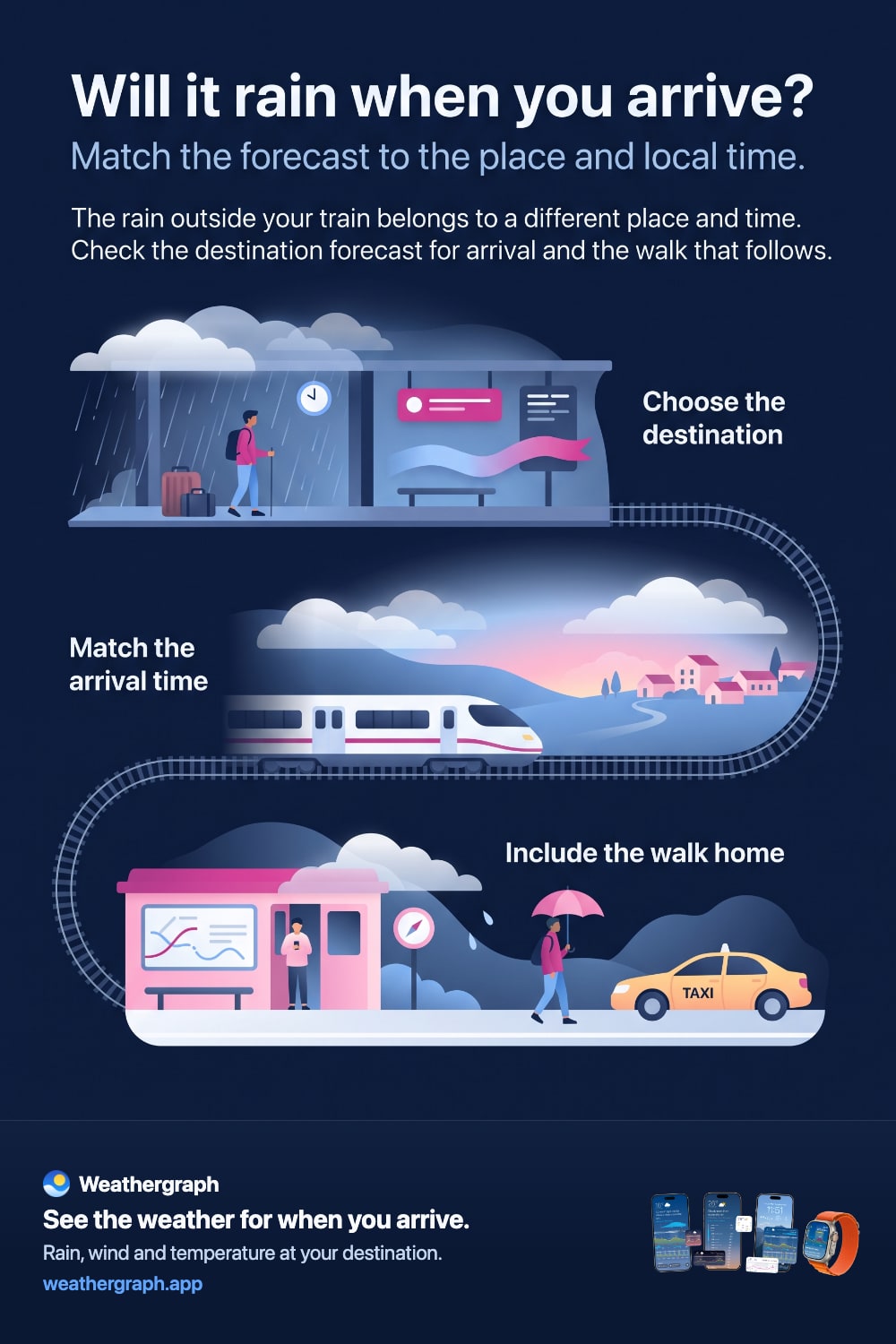
Choose the destination first, then find your arrival time and the period you will spend outside. Rain outside the train window says little about the walk home from a station you will reach later.
A forecast becomes useful when its place and time match the decision. “Will it rain today?” is broad. “What is expected at my station between arrival and the end of my walk?” gives you something concrete to compare.
Taxi or walk: read the last part of the journey
Suppose your train arrives at 18:30 and the walk home takes 25 minutes. Look at the forecast around 18:30–19:00 at the destination, with some room for a delayed arrival.
- Check the location label. Make sure you are reading the station's area, rather than your current GPS location or a similarly named town.
- Match the clock. Use the local arrival time and confirm how the forecast labels its time zone, especially when crossing a border or midnight.
- Read rain likelihood and amount together. A rain percentage does not describe the fraction of your walk that will be wet.
- Include the whole walk. A dry-looking arrival hour is less useful if conditions change before you get home.
- Recheck nearer arrival. Short-range precipitation information may help as the decision approaches; see nowcast, radar and hourly forecasts.
The NWS hourly-forecast guide shows how selecting a period and relevant weather elements makes an hourly forecast practical. The method here applies that idea to the part of your journey where weather affects your choice.
The same method works for places you care about
| Place | Question to put beside the forecast |
|---|---|
| A boat's mooring | How are wind and gusts expected to change there while I am at home? |
| Family in another country | What does their upcoming day look like in their local time? |
| A mountain destination | What weather is expected where I will be, rather than down in my home town? |
A saved place can represent a plan, a responsibility or someone you care about. You do not need to be traveling there today for its forecast to be meaningful.
In Weathergraph, choose the destination in the app and confirm the displayed place before reading its graph. Check each widget or Watch surface separately rather than assuming it follows the location currently open on your phone. The Weathergraph FAQ documents location behavior.
A winter journey: watch the transition, then check the road
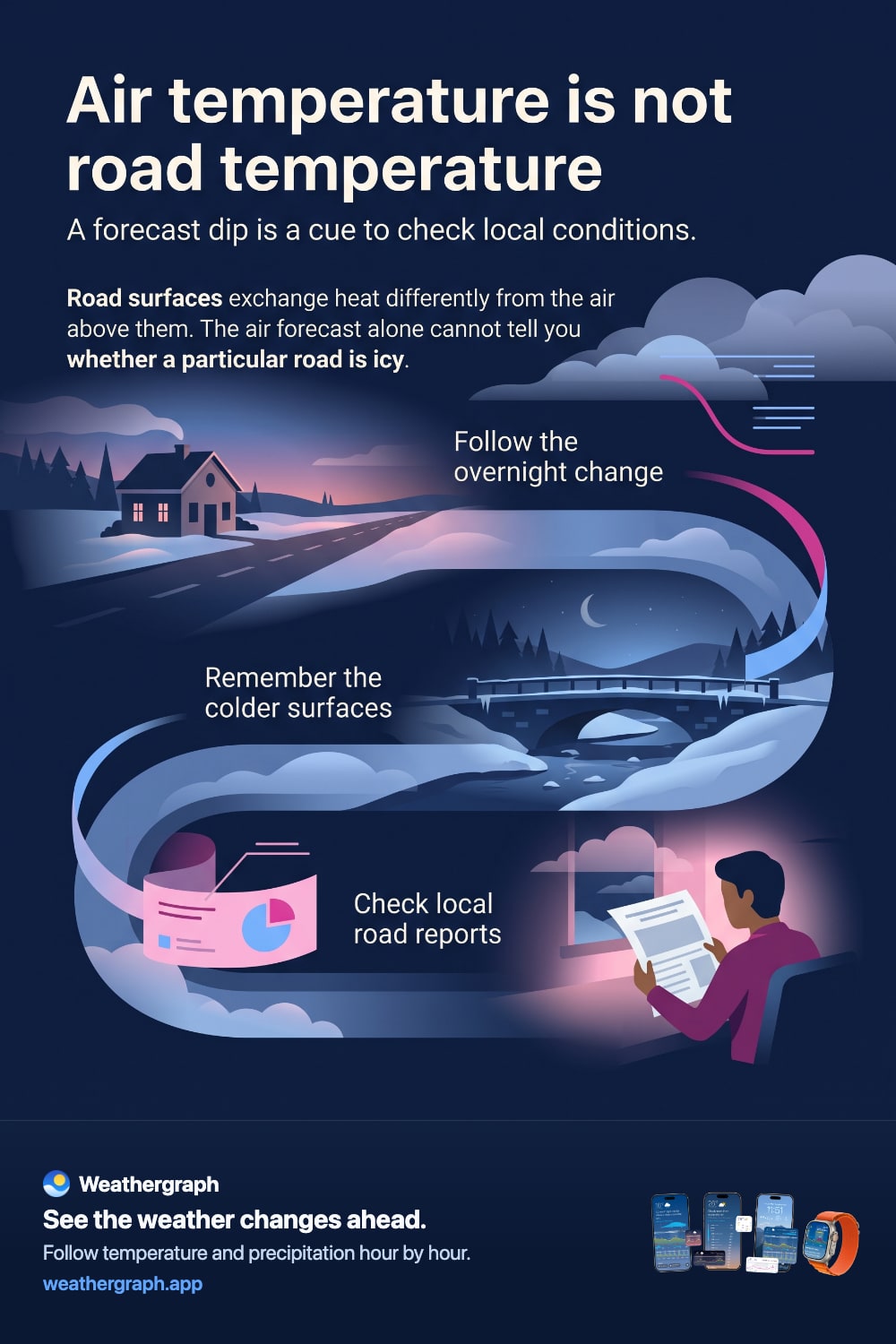
Air temperature is not road temperature. Illustrative scenes; consult current local reports.
A temperature curve dipping toward freezing is a reason to look more closely at the hours of travel. It is not a road-temperature measurement.
Road surfaces and the air above them can have different temperatures. Bridges and overpasses can freeze before other surfaces. Check official road reports and local warnings rather than treating a positive air temperature as proof of an ice-free road. NWS winter-driving information and ice guidance.
Keep the place, time and question together
Before acting on a distant forecast, check three labels: which place, which local hour, and how long your plan lasts. Then choose the relevant layers: rain for a station walk, wind for a mooring, or temperature and precipitation for a mountain visit.
Forecasts can change. Local road, harbor, resort and official warning information provide context that a general hourly weather view cannot supply. The useful habit is to match each source to the question it can answer.
Weathergraph
Keep the places you care about in view
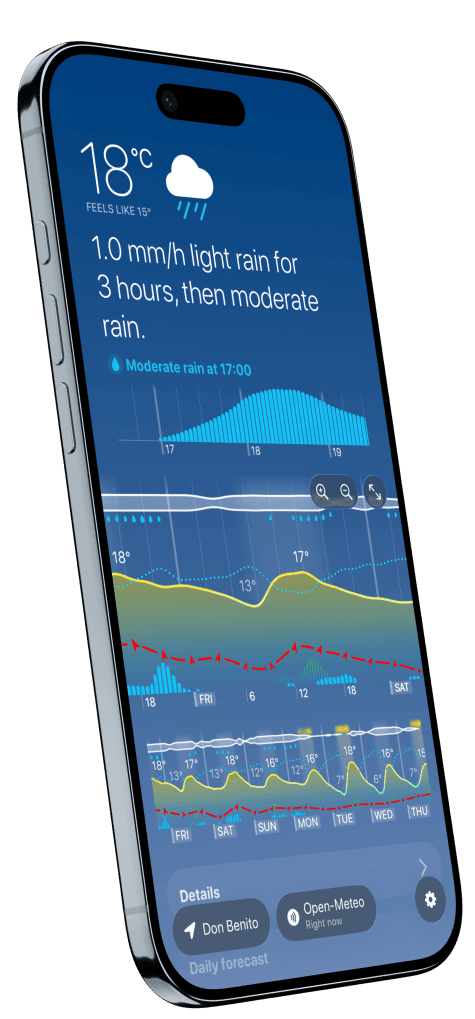
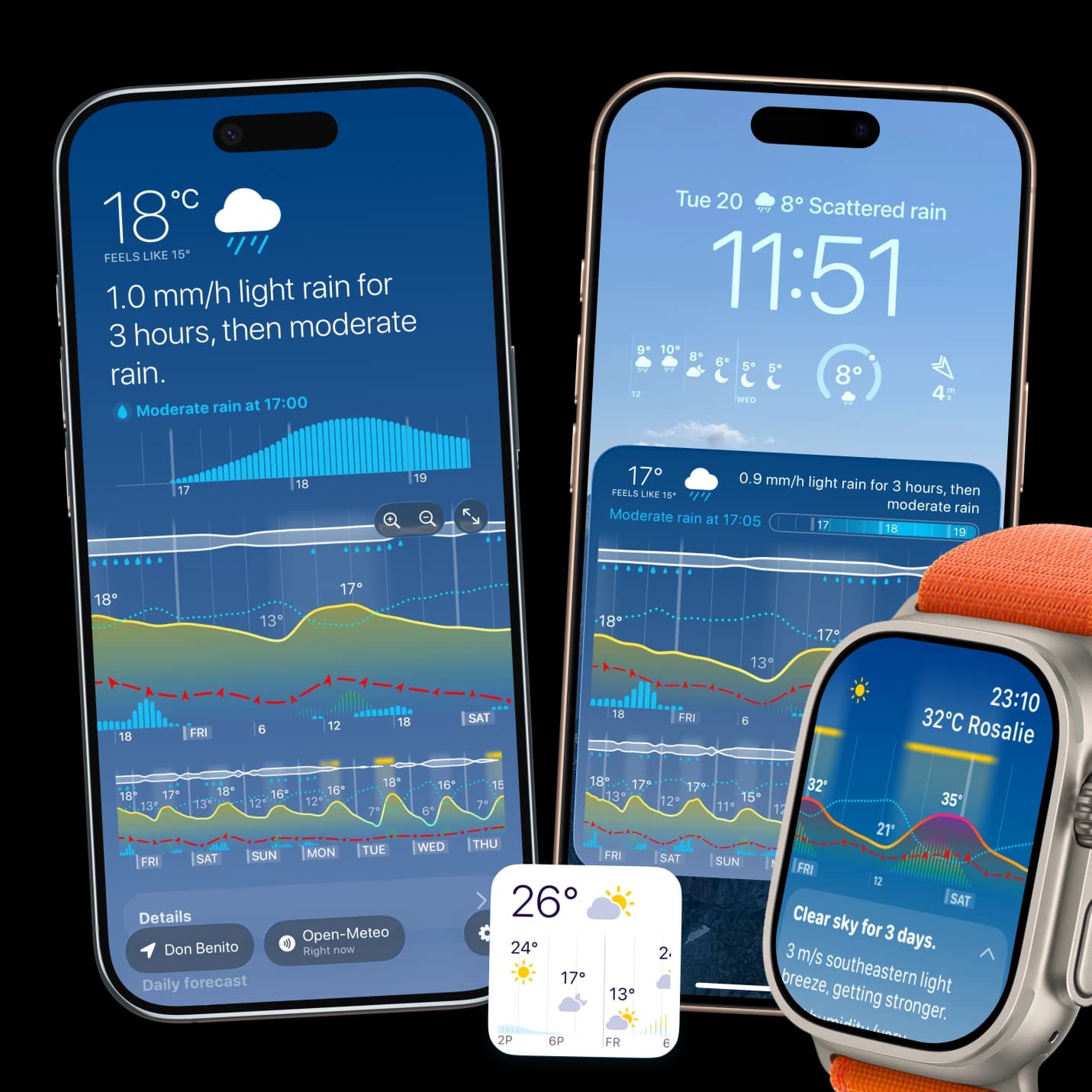
Weathergraph lets you explore destination forecasts as hourly graphs. Compare the rain, wind and temperature expected where your plans take you.
