Weather guide
Will opening the windows make your home less humid?
Compare indoor and outdoor dew point to understand whether ventilation can remove moisture, then check temperature separately if you also want to cool the room.
Updated September 8, 2026
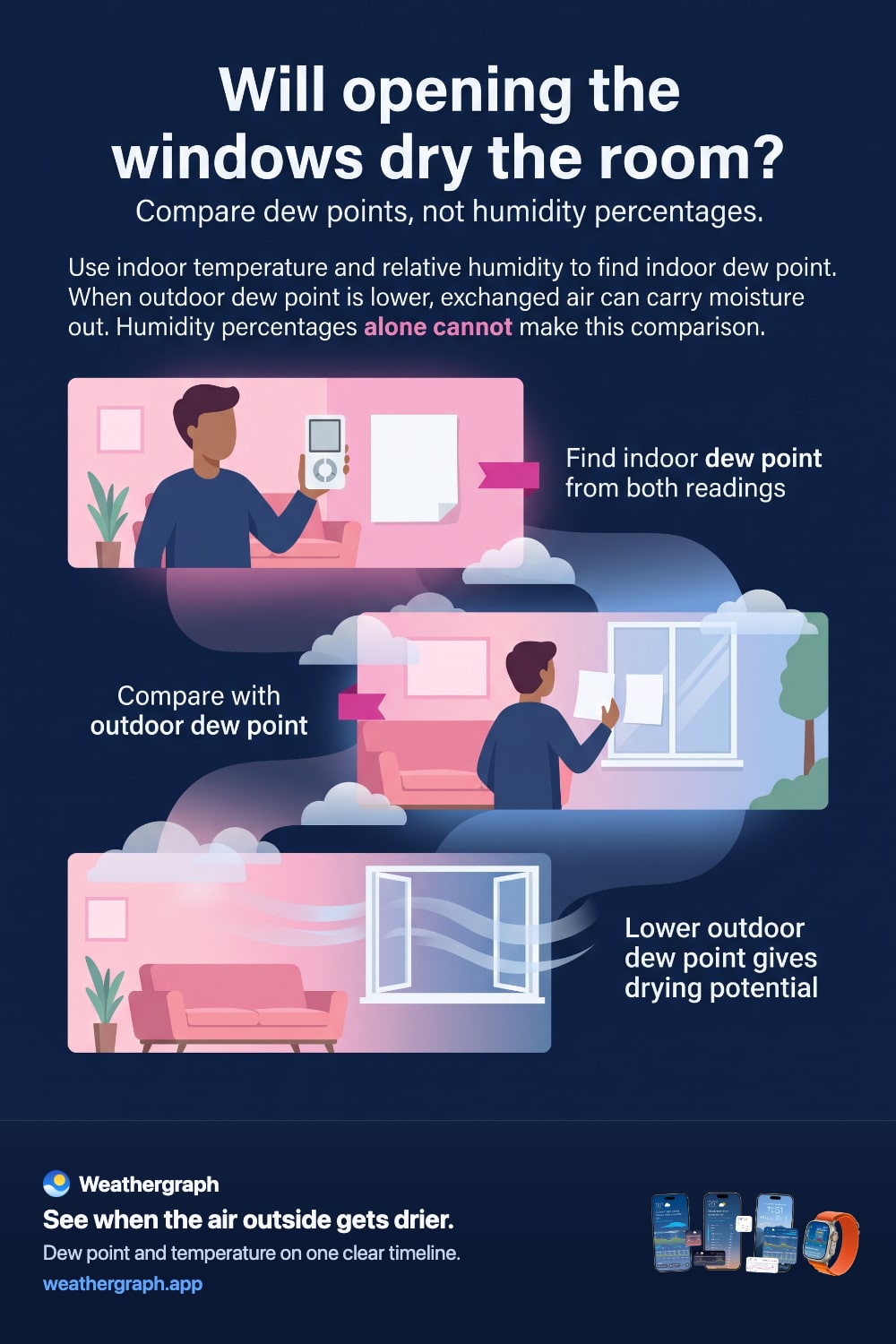
To judge whether opening a window could remove moisture, compare the outdoor dew point with the indoor dew point. A lower outdoor dew point indicates drier incoming air at comparable pressure. To judge cooling, compare the temperatures as well. Drying a room and cooling it are different jobs.
An indoor humidity meter and an outdoor forecast become much more useful when you give them the same question to answer. Two relative-humidity percentages by themselves can be misleading because the temperatures may differ.
Why the percentage can send you in the wrong direction
Relative humidity describes how close the air is to saturation at its current temperature. Cool the same air without changing its moisture, and that percentage rises. Dew point is the temperature at which cooling would bring the air to saturation. This makes it a useful reference when comparing indoor and outdoor air. NWS dew-point definition.
Imagine an indoor meter reading 22°C and 60% relative humidity. Its dew point is about 14°C. Outdoor air at 10°C and 90% relative humidity has a dew point of about 8°C. The outdoor percentage is higher, yet the outdoor air contains less water vapor at comparable pressure. Bringing it in and warming it does not add the moisture needed to preserve that 90% reading.
These are rounded illustrative calculations, not measurements of your home. Enter both indoor temperature and relative humidity into a dew-point calculator, or use a meter that displays dew point. Keep both sides in the same units. NWS weather calculators.
Separate the two comparisons
| Your aim | Compare | What the comparison tells you |
|---|---|---|
| Remove moisture | Outdoor dew point versus indoor dew point | Lower outside means ventilation has drying potential. |
| Cool the room | Outdoor air temperature versus indoor air temperature | Cooler outside provides potential for ventilation cooling. |
| Protect cold walls or floors | Outdoor dew point versus the cold surface temperature | Incoming air can condense if cooled below its dew point against that surface. |
A cooler evening is not necessarily drier. For example, the outdoor temperature can fall after sunset while the dew point stays nearly unchanged. You may gain cooling without gaining much drying.
A practical window check
- Take a current indoor reading. Note temperature, relative humidity and the time. Derive indoor dew point if your meter does not show it.
- Read the outdoor dew point for the hours ahead. Look for a period below the indoor value, rather than simply choosing the lowest outdoor humidity percentage.
- Check temperature for comfort. A drying opportunity can also cool the room more than you want in winter, or fail to cool it in summer.
- Consider the room itself. A cold cellar needs an additional surface check; use the cellar ventilation guide.
- Recheck the indoor conditions afterward. The result depends on airflow, how long you ventilate, and ongoing moisture from cooking, washing or drying laundry. A forecast is a planning input, not a measurement at your window.
Do not treat a tiny difference between two readings as a reliable dividing line. Meter accuracy, forecast uncertainty and changing indoor conditions matter.
Use Weathergraph for the outdoor half
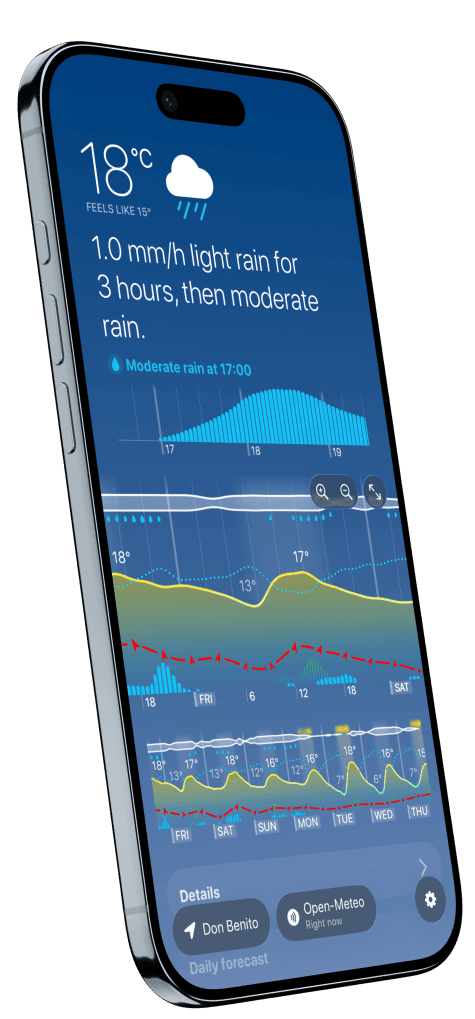
Look at the upcoming dew-point and temperature trends in Weathergraph, then compare them with your own indoor measurements. A falling outdoor dew point may reveal a better opportunity later. The app supplies the forward forecast; your humidity meter supplies the indoor context.
For the underlying weather concept, see dew point versus humidity. For reading several hours together, use the hourly graph guide.
Moisture is one reason to ventilate
Fresh-air needs, outdoor smoke or pollution, rain entering the window, and a building's ventilation system also affect the decision. A moisture comparison does not replace a ventilation requirement or diagnose persistent dampness. The German Environment Agency explains how moisture sources, ventilation and cold surfaces interact in its home ventilation guidance.
If the room remains damp despite suitable ventilation, investigate the source of moisture rather than assuming a different forecast hour will solve it.

Weathergraph
Find the hours with drier outdoor air
Weathergraph shows the upcoming dew-point and temperature trends together. Pair that outdoor forecast with your indoor readings to understand when the air outside changes.
