Weather guide
When should you ventilate a cellar? Check dew point and cold walls
Fresh summer air can leave a cold cellar wetter. Learn the two comparisons that separate moisture removal from condensation on walls and floors.
Updated September 8, 2026
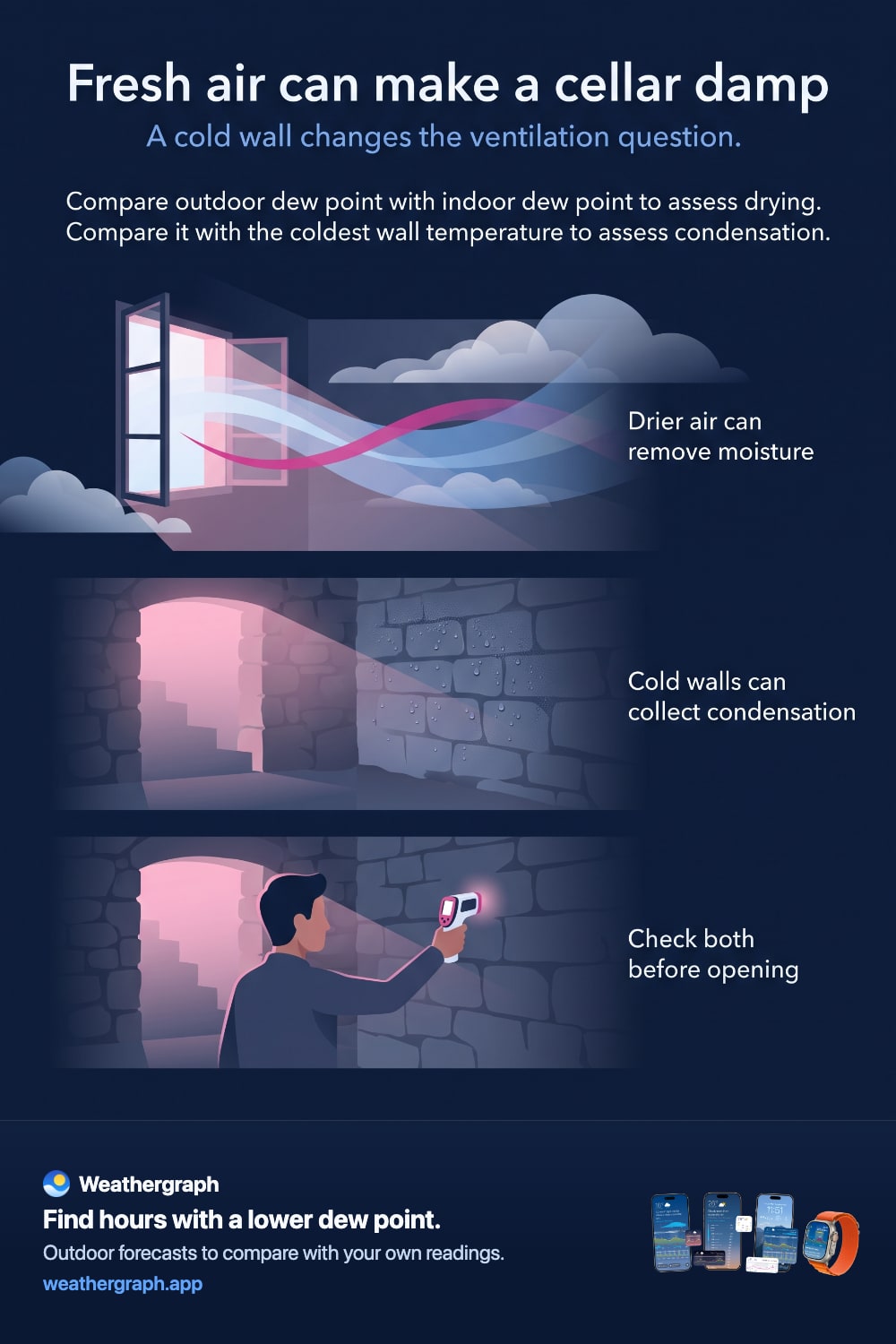
Before ventilating a cool cellar, compare the outdoor dew point with two things: the indoor dew point and the temperature of the coldest relevant wall or floor. The first comparison tells you whether incoming air has drying potential. The second tells you whether that air could condense against a cold surface.
This explains a familiar frustration: opening the windows on a lovely warm day can make a cellar damper. The walls below ground can remain cold while the outdoor air carries much more moisture. The German Environment Agency specifically identifies warm summer air condensing on cold cellar walls as a moisture problem. Cellar ventilation guidance.
The cold-glass effect, on your wall
Think of water appearing on the outside of a cold drinking glass. The water comes from vapor in the surrounding air, which cools at the glass surface. A cellar wall can play the same role.
Dew point is the temperature at which air reaches saturation as it cools without changing its moisture content or pressure. A surface colder than that dew point can collect condensation. The important comparison is therefore with the wall's surface temperature, which can be lower than the air temperature in the middle of the room. NWS dew-point definition and dew definition.
Two checks, two different answers
| Question | Comparison | Interpretation |
|---|---|---|
| Could ventilation remove moisture? | Outdoor dew point below indoor dew point | Incoming air has less water vapor at comparable local pressure. |
| Could incoming air condense on this surface? | Outdoor dew point above the surface temperature | Condensation is possible as the incoming air cools against it. |
Both checks matter. Passing the drying comparison does not automatically pass the cold-wall comparison.
A worked example
Suppose the readings are:
- Indoor dew point: 18°C / 64°F.
- Outdoor dew point: 16°C / 61°F.
- Cold wall surface: 12°C / 54°F.
The incoming air is drier than the indoor air. But its dew point is still above the cold wall's temperature, so it can condense there. “Drier outside” and “no condensation on the wall” are different conclusions.
These values are an illustration, not a measurement of your cellar. A lower outdoor dew point than both references is a more favorable moisture condition, but the size of the difference and the reliability of the measurements still matter.
What to measure before comparing the forecast
Use an indoor temperature-and-humidity meter to obtain or calculate indoor dew point. Separately measure the cold surfaces that incoming air might meet, including a cold wall or floor. Follow the measuring device's instructions; one warm wall reading does not describe every corner.
Record the time of each reading. Conditions can change during ventilation, and an outdoor forecast may differ from the air beside the house. If the surface temperature is unknown, you can compare drying potential, but you cannot confidently rule out condensation on that surface.
There is no universal number of minutes or single temperature difference that makes every cellar suitable for ventilation.
Find the upcoming hours worth checking
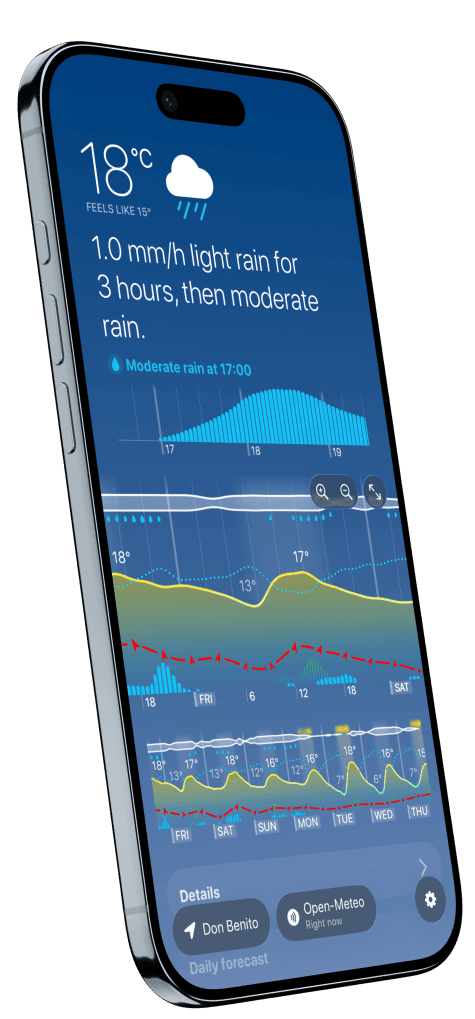
Weathergraph can show the outdoor dew-point trend alongside temperature. Use it to look for a lower-dew-point period, then repeat the indoor and surface checks close to that time.
Cooler nights and mornings are often suggested for summer cellar ventilation, but the clock is a shortcut, not the physical test. Night air can remain moisture-rich. The outdoor dew point and the actual cold surfaces decide the moisture comparison.
For ordinary rooms, the simpler indoor-versus-outdoor ventilation guide separates drying from cooling.
When the cause is more than the weather
Ventilation cannot repair leaking pipes, missing waterproofing or moisture entering through the ground. Persistent dampness, visible mold or water damage needs investigation of the building and moisture source. Avoid interpreting “no visible condensation” as proof that all moisture or mold risks are absent.
This guide explains the comparisons behind a ventilation decision. It is not a diagnosis or a building-control system. The outdoor forecast, indoor measurements, surface temperatures and the building's ventilation needs all belong in the picture.

Weathergraph
See when the outdoor dew point changes
Weathergraph puts future dew point and temperature on an hourly timeline. Use that outdoor context alongside your cellar measurements when considering ventilation.
