Weather guide
Picking the best hour of the day to run
The best running hour is rarely the warmest one. Read temperature, dew point, rain timing and UV as one timeline, and the comfortable window usually picks itself.
Most running apps tell you the temperature right now. That is the one number that matters least. The hour that will feel best for a run is decided by temperature and dew point together, by when rain actually arrives rather than whether it is forecast, and by where the UV peak sits — and all three are questions about a timeline, not about this minute.
The quick answer
- Look for the hour where temperature and dew point both drop, not just temperature. A 22 °C evening at 18 °C dew point is harder work than a 26 °C morning at 9 °C.
- Read rain as timing, not as a yes/no. "60% chance today" is useless; "bars start at 16:00 and stop by 17:30" is a plan.
- Check UV if you are out for more than about forty minutes in summer — the peak is usually two hours wider than people expect.
- Pick a two-hour window, not an exact time. Forecast timing drifts; a window survives the drift.
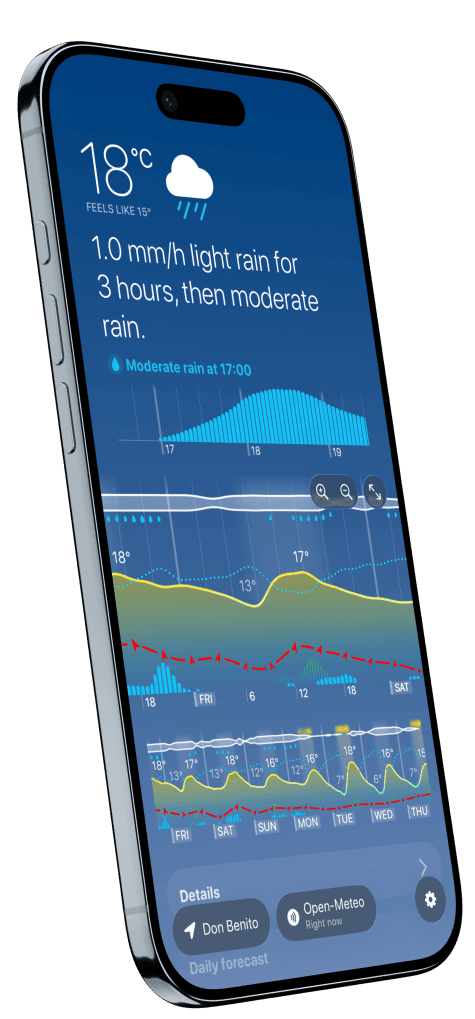
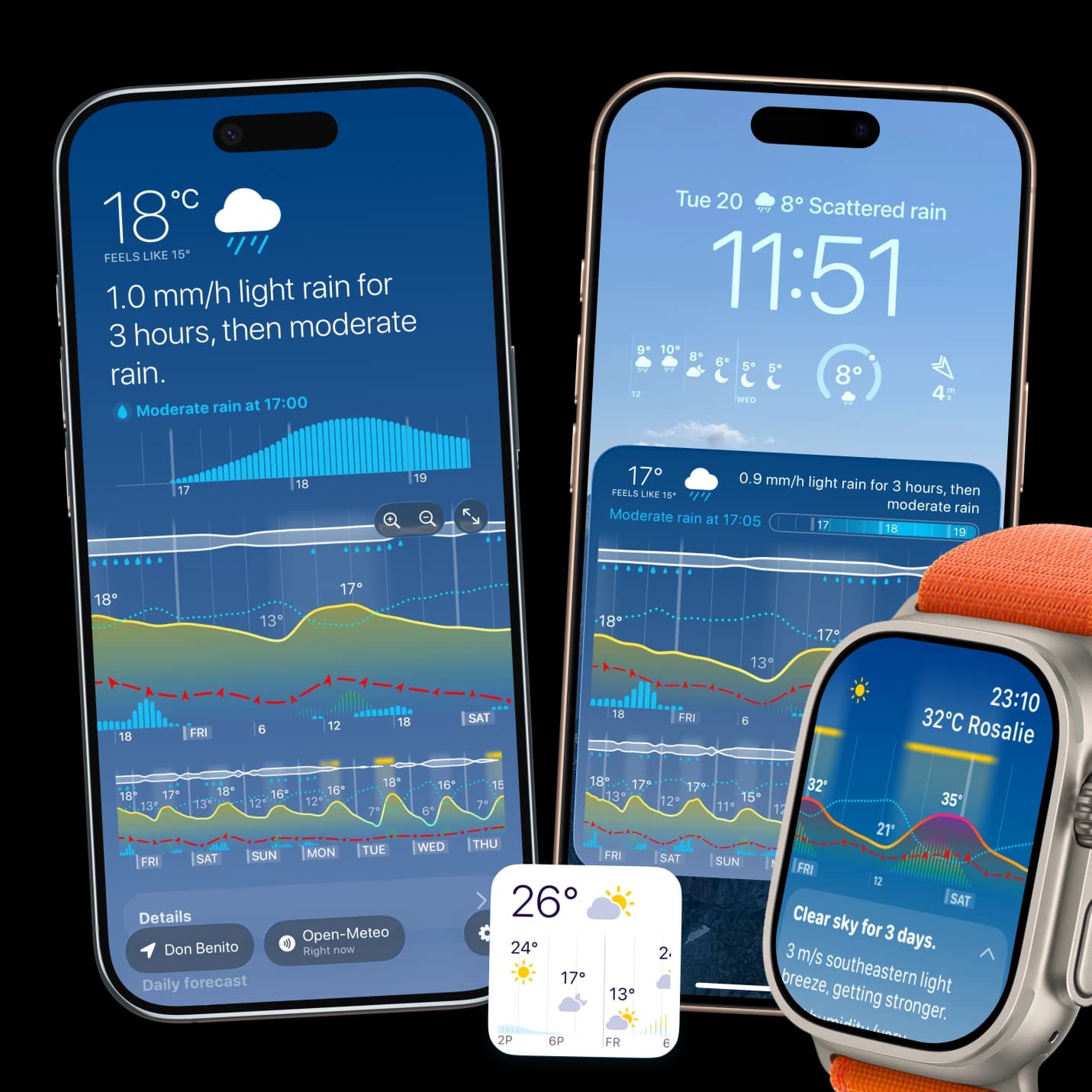
- In Weathergraph all of that is one chart: the yellow temperature curve, a dotted dew-point line you can switch on, precipitation as both amount and probability, and the wind line with gust arrows. The same graph sits on the Apple Watch face, which is the version you actually check on the way out of the door.
Why dew point beats humidity for runners
Relative humidity moves when the temperature moves, so it tells you less than it looks like it does: 90% at dawn and 45% at noon can be the same amount of water in the air. Dew point is an absolute measure, so it can be read as a single scale, and it maps closely to how hard sweating gets.
| Dew point | What a run feels like |
|---|---|
| Below 10 °C | Dry. Cooling works normally. |
| 10–15 °C | Noticeable, still comfortable for most efforts. |
| 16–20 °C | Sticky. Expect to slow on the same effort. |
| Above 20 °C | Cooling is genuinely impaired. Shorten, slow down, or move the run. |
The US National Weather Service explains the difference between dew point and relative humidity in its dew point discussion. Our own dew point guide goes further into why the two diverge.
Read the day, then choose
- Scan the temperature curve for the flat part. Early morning and the hour before sunset are usually the two candidates; the curve tells you which is flatter today.
- Overlay dew point. If it stays high overnight, the morning advantage disappears — that is the case people get wrong most often.
- Find the rain gap. Look at when bars start and stop rather than the daily probability. A 90% day with a clear three-hour gap is a better running day than a 40% day of scattered showers.
- Add wind last. For an out-and-back, start into the wind so the tired half is the tailwind half. The direction arrows on the wind line tell you which way that is.
What this looks like on the wrist
The decision usually happens in the ten seconds before you leave, which is why it belongs on the watch face rather than in an app you have to open. A complication that shows the shape of the next hours — not a single temperature — answers "now or in two hours?" without a tap. That is what Weathergraph's Apple Watch complications are built around.
A note on heat
None of the above replaces caution in genuine heat. When dew point is above 20 °C and the temperature is high, the limiting factor is your body's ability to shed heat, and no amount of good timing changes that. Move the session, shorten it, or take it indoors.
Weathergraph
Find your window before you lace up
Weathergraph puts temperature, dew point, rain timing, wind and UV on one hourly timeline, with the same graph on your watch face—so the decision takes a glance, not four apps.
